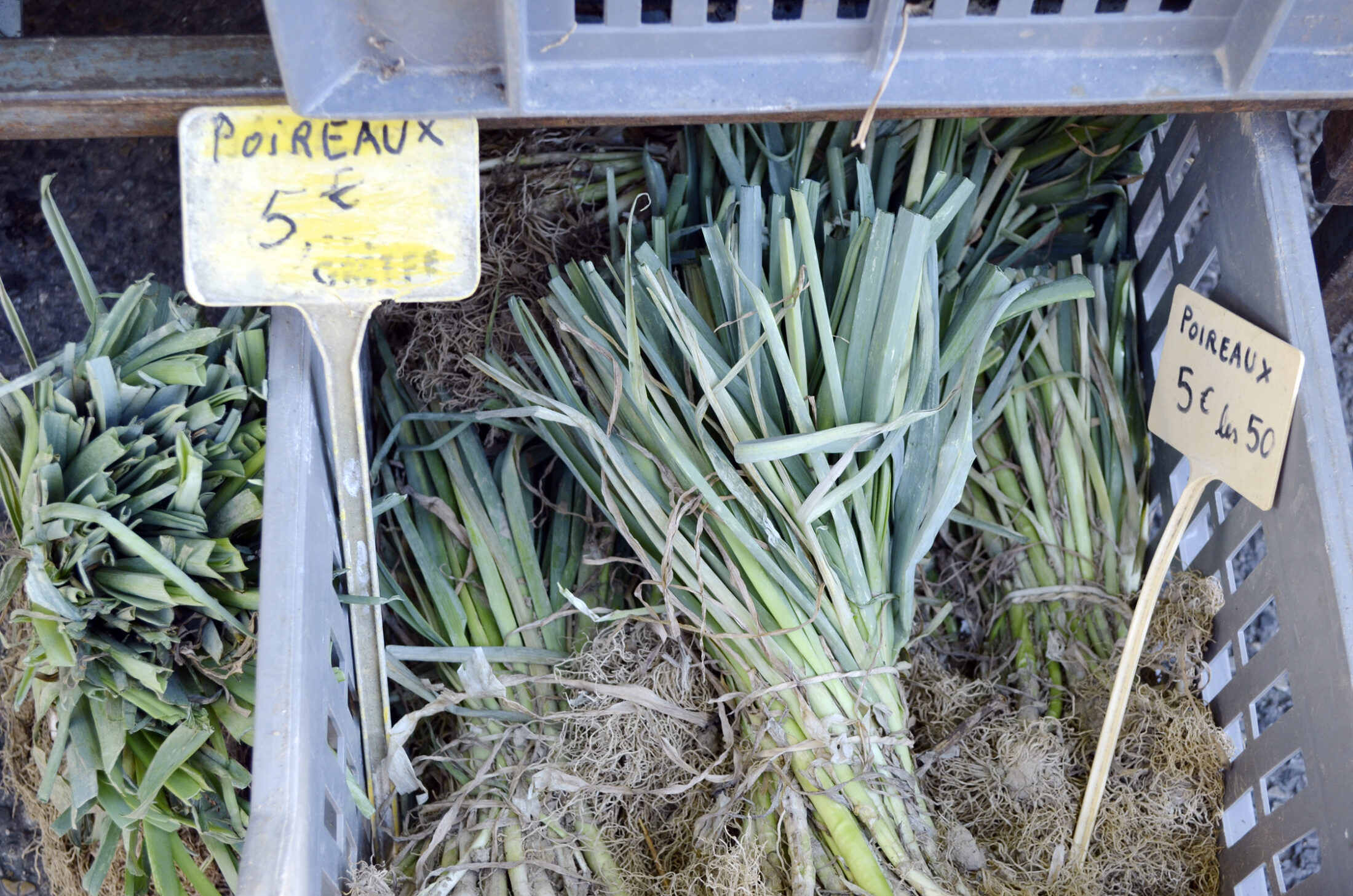
Winter leeks have a blue tinge to their leaves. These are being sold right now at Vaison la Romaine market on Tuesday mornings.
Repiquage des Poireaux d’Hiver
For those of you who aren’t kicking yourselves for enthusiastically sowing hundreds of seeds when the first spring blossom appeared (the sprouting weeds somehow not reminding you of the seemingly unmanageable workload that comes with a ‘potager’ of a decent size), you will most likely be thinking of planting your winter veggies. I would suggest planting leeks in Provence.
French Leeks
The stereotype of a Frenchman and his leeks is true. Right now the sunflowers have been replaced with fields and fields of them here in Provence. For good reason as well. Leeks are delicious! You may say yes- but they are a pain because you always end up with the unpleasant sensation of grit between your teeth. I must say that in France, this has never happened to me. I often don’t even rinse my leeks.
Disallowing Photosynthesis
I’ve been told this is because, in North America, leeks are grown industrially and are treated in such a way that favours dirt getting into all the sweet, white layers of the leek’s stem. Leeks are sown and then, like potatoes, dirt is pilled up against the stalks to blanch the stem and keep it from sunlight. This is done by machines that get the dirt just about everywhere, including in the centre of the plant which is where the dirt stays.
Here, Leeks are sown twice. You start your leek seeds in the spring and carefully nurture them until the stalks are about the thickness of a crayon. This will take a couple months. Then, you plant those seedings deep in the soil during the summer months so that you may have leeks all winter.
Right now, at many markets in Provence, you’ll find paysans who have kindly done the initial nurturing for you. All you have to do is plant the seedlings. These specimens will have spent some time out of the soil which is actually a good thing because it will help prevent leek worm.

These bunches might look like a lot of leeks… Trust me- throughout the winter months you’ll get through them. Combined with butter, bacon bits and cream you have the base of a great many delectable winter meals.
Le Repiquage (transplanting)
Dig some compost into the soil before you plant. Leeks are ‘plantes gourmandes.’ Dig a long deep trench. Or, prepare your dibble (tool for planting long and deep holes).
Trim the tender roots of your seedlings so that you have only a couple centimetres of root left. Trim also the last third of the leaves. This will help the plant re-establish itself.
Transplant the leeks so that the roots are firmly in the soil and the soil reaches all the way to the first green leaves. Plant them 10-15 centimetres apart and plant rows 20 centimetres apart. Make sure the leaves are all facing the same direction to facilitate piling the soil around the stems.
Water well. After the first couple of weeks, or until the plants are established, slow watering down to an inch a week. Rain may do this for you in the autumn months. The soil should always retain some moisture around your leeks. Mulch with straw for even better results. Also, watch out for slugs when the plants are young. Set beer traps if you need to!
When the stems are about an inch thick, start piling up the surrounding soil to hide the stems from the sun so that they stay tender and sweet. Keep doing this until you harvest. You can harvest anytime. When still small and thin, use them as scallions. The harvest is generally in November but you can keep your leeks in the soil all winter so that they’re fresh until the Spring. Happy planting!!
Want to practice some French? Magazines can be less daunting than trying to read Candide. If you’re a gardener, try Rustica Magazine.


Leave a Reply