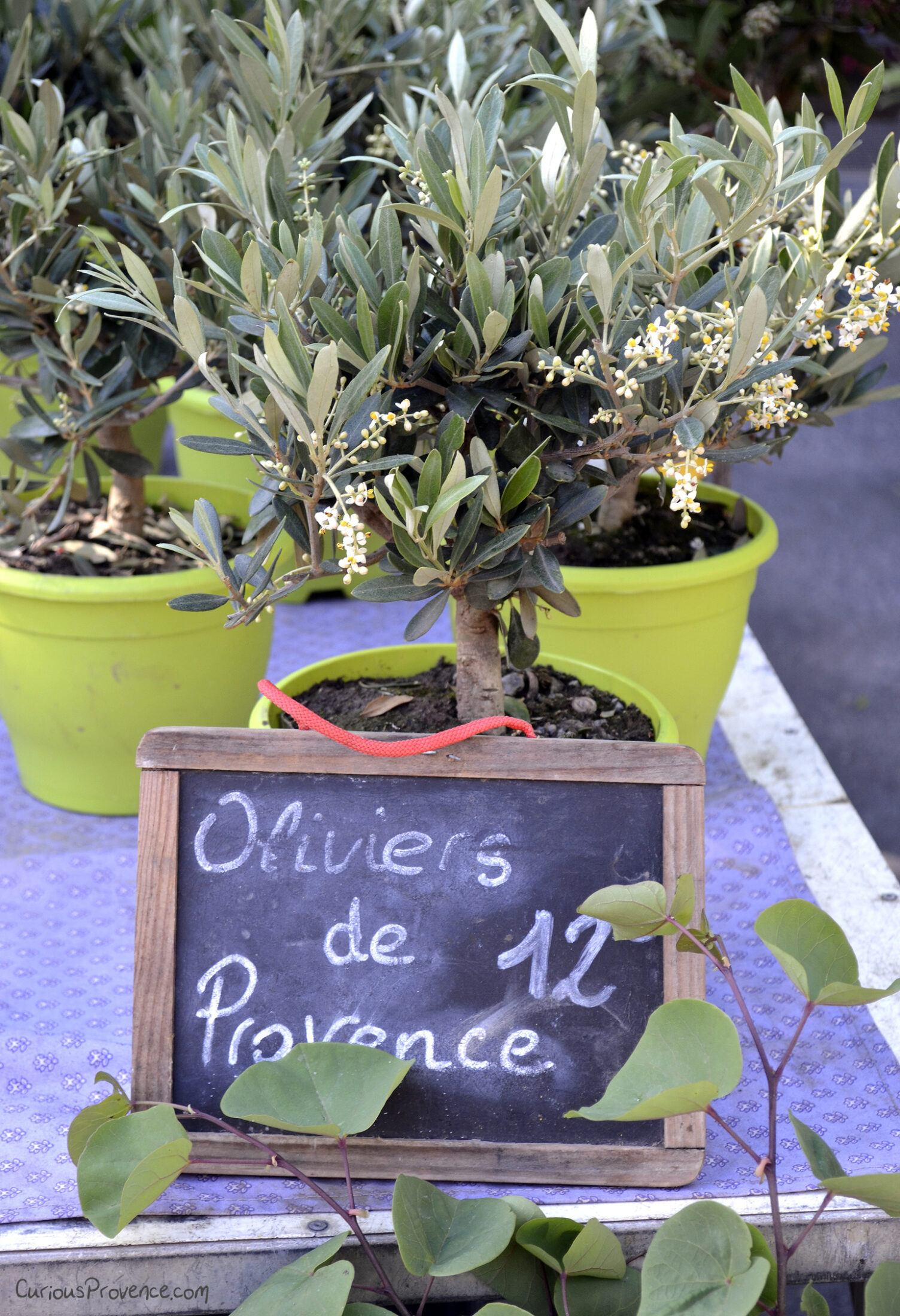
Flowering olive trees sold by Pepiniere Cabanelle at Ste Remy de Provence market
Here is a guide on how to take care of that irresistible little olive tree you bought to diversify your garden (if you weren’t traveling by plane that is).
You may look at those little trees and think that ‘Oliviers’ won’t grow where you live- but with the right care, you’ll be surprised.
The little dwarf olive trees you see in florists and at the market are already about 4-5 years old. Olive trees grow slowly but can live for 1,000 years. A lasting souvenir of Provence indeed!
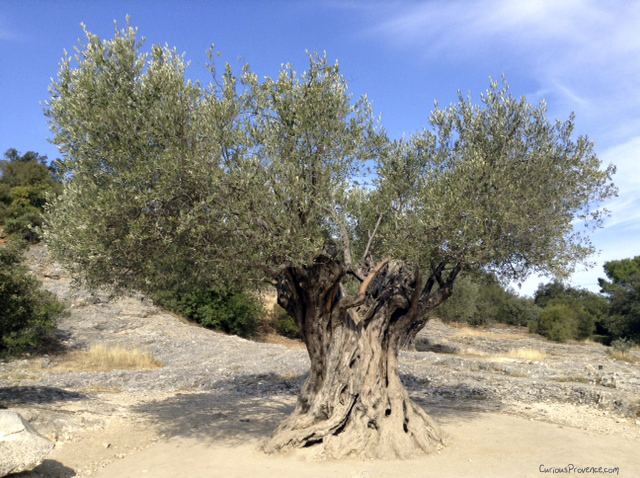
1,000 year old olive tree imported from Spain planted at the site of the Romain aqueduct Pont du Gard close to Nimes and Uzès.
Re-potting
One of the first things you should do when you bring your little ‘Olivier’ home (after naming it of course) is to re-pot it. The little pots they are sold in are often plastic and retain no water. This means that your tree will require more watering and will most likely be blown over easily by gusts of wind. The pepinieriste that I work for at the Ste Remy Market on Wednesdays says that being in such a small pot is like trying to suck water out of a tiny cup with a tiny straw…or something like that.
Olive trees grow according to the size of pot they’re in. So plan accordingly. If you plant your tree directly in the soil you can have a full-grown tree in around 10 years depending on weather conditions.

These are currently being sold at a local cave (wine cooperative)
Watering
If you don’t want to re-pot your olive tree it will need watering every 2 days depending if you’ve put it in the hot Provencal sun or not.
Once re-potted in a sandy, well-draining soil (always in a pot with a drainage hole and stones at the bottom to facilitate draining). The week after you’ve re-potted make sure to water your tree every day to help establish roots. Afterward, you will need to water your little tree 1-2 times per week. In the winter, you can stretch this to once every 2 weeks.
If you live in a cold climate- fear not! Olive trees freeze around -15 degrees Celsius. The real problem with olives is sitting in wet soil. So, you can leave your tree outside but out of the rain. You can also bring it inside but always remember that this plant loves full sun.
Fertilization
Fertilize your plant during the growing season (March-October) and only a little at a time. Be careful with compost and mulches, these are often too heavy and moisture-retaining for olive trees. A normal store-bought nitrogen-based fertilizer will work well. Of course, you can also buy fertilizer especially for olive trees but it isn’t necessary.
Pruning
The olive tree doesn’t need pruning (as do some other trees) to produce fruit (or, at least it doesn’t need pruning until it’s quite a seasoned tree). Therefore, you only need to prune to retain whatever shape you like. Do this in the autumn. I know that TreeQuote down the road offers tree pruning if you’re not sure what you’re doing. I must say that I like a wild looking tree…
Olive Tree Pests
The olive tree is one of the hardiest trees in terms of drought-resistance and pest-resistance. Here in Provence nothing really attacks the trees but there are sometimes problems with a fly that attacks the fruits. In less dry environments check the undersides of leaves regularly just in case there is an outbreak of scale. In which case, spraying lemony soapy water on the undersides of the leaves works well. Also, you can use an organic Savon de Marseille spray made for plants.
Et voilà! Follow these tips (even loosely) and you’ll have a lovely little olive in your garden that, if happy, will produce olives. Remember that you can’t eat olives right off the tree- they need to be soaked in brine. If you don’t believe me, I dare you to try one…
A little tree won’t give you enough olives to brine yourself, but if you want to give it a try, see my recipe for brining your own olives.
Olive trees are one of my favourite subjects to paint. See some examples here.


Enjoyed these tidbits about Provence’s olive trees. I participated in my first olive harvest last autumn, in Malta, and am hoping to be somewhere in the Mediterranean later this year so we can do so again. It’s hard going back to ‘commercial’ olive oil after savoring the bottle made from the olives we helped harvest. 🙂
What an awesome article about olive trees and how to care for these wonderful trees. That’s a beautiful picture at the top btw!
We have many wonderful olive trees local to us here in Ventura Ca
Thank you! I think we share a very similar climate. I’m sure you have all the same foraging potential in California.
What do you think is the ideal weather for raising olive trees? Also how fast do they grow?
Olive trees need lots of sunlight and well-drained soil. They grow well here in the Mediterranean as well as California. They can grow in pots as long as the soil is well drained. They grow quite slowly. Smaller trees can be harmed by temperatures below 8°C. Otherwise, they’re lovely!
Adore these trees. Thanks for the growing tips!
I’m wanting to bring one of these back to the US with us. Any experience with what to expect or get cleared for by customs?
Hi Jay, I’m pretty sure you can’t bring any soil into the States so I think it’s near impossible. Though, olive trees do withstand re-potting very well so there might be a way to bind the roots but I’m not sure.
Hello,
In August, I germinated an olive seed (in a damp paper towel) and then – about two weeks later after the roots developed –I planted it. “Olea” now stands at nearly 4 inches tall. I have Olea in a pot that is roughly 3.5 inches deep and 3.5 inches wide.
My question is how long I can leave Olea in this pot before placing she/he (?) in a bigger pot?
Also, can I place Olea in any size pot, or do I need to go up slowly size by size?
Oh, and does it matter the time of season when transplanting takes place?
Thanks!
Darren.
Hi Darren, That’s fantastic that you were successful in germinating Olea. I would transplant in the Fall, now would be great, and only a pot that is about 2.5 inches bigger. Once Olea is in that pot, you can leave her (him?) in the pot for a long time as olive trees grow very slowly and only according to the pot that they’re in. If you’d like it to grow faster, transplant it into a bigger pot. Here in Provence, once they are about 1.5 feet high, they are planted directly into the soil.
Thank you very much for the info!
Unfortunately, I live in Canada, so I’m afraid Olea is going to be stuck in a pot for life.
Thanks, again!